BenQ HT2050A 1080p Home Theater Projector: Deep Teardown & Budget Analysis
An exhaustive hardware teardown and budget value analysis of the BenQ HT2050A 1080p Home Theater Projector ($749.00 MSRP). Discover why its glass optical engine, Rec.709 color wheel, and low input lag keep it at the top of the budget projection hierarchy.
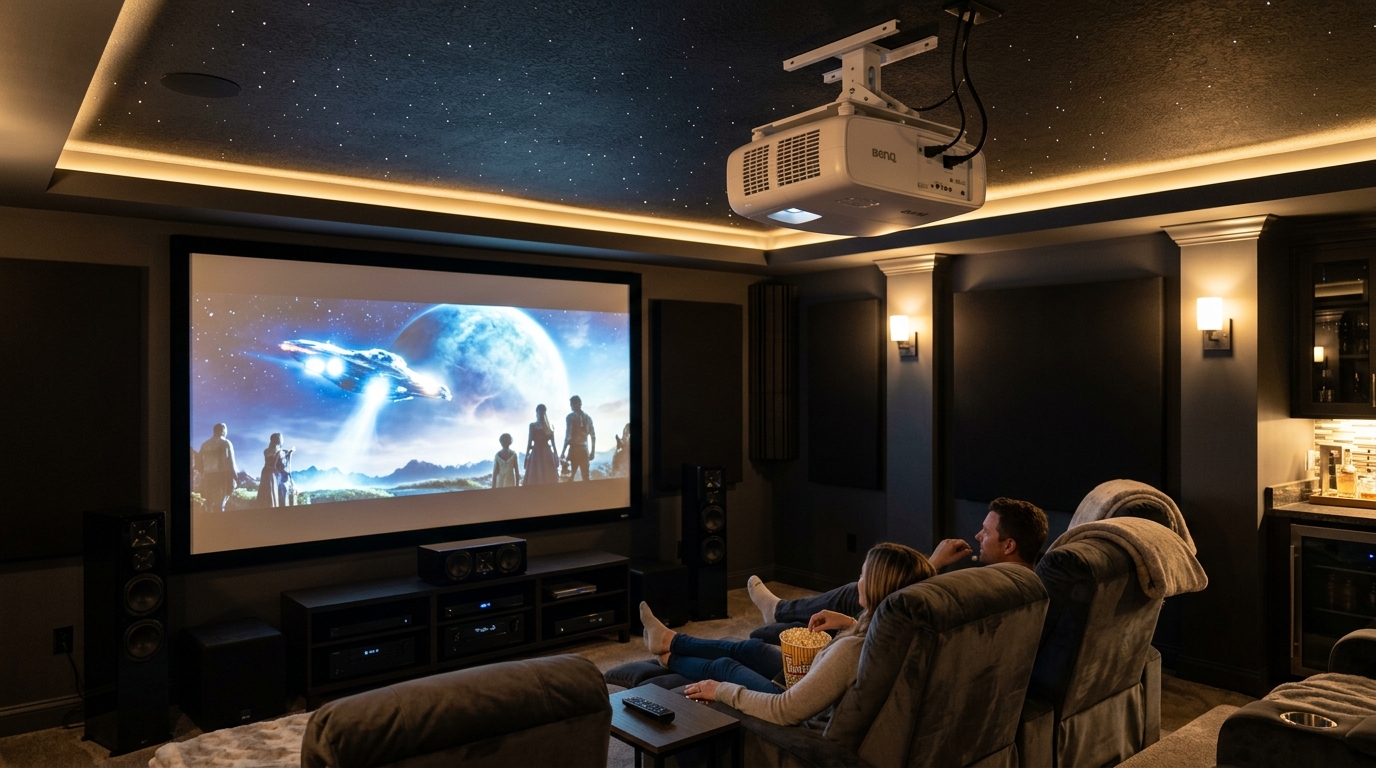
Finding true home cinema performance under $1,000 remains one of the toughest challenges for home theater builders. While modern marketplaces are flooded with compact LED projectors promising high brightness and smart apps, most sacrifice the fundamental pillars of image quality: high native contrast, precise color reproduction, and low-dispersion glass optics. The BenQ HT2050A 1080p Home Theater Projector ($749.00 MSRP) has long stood as the reference benchmark for budget-conscious home theater enthusiasts.
In this comprehensive hardware teardown and value analysis, we open up the internal optical chassis of the BenQ HT2050A, evaluate its Texas Instruments DLP chipset, analyze its RGBRGB color wheel, measure its low-latency gaming engine, and determine why this $749.00 MSRP projector continues to outperform more expensive competitors.
Optical Engine Teardown & Hardware Architecture
To understand why the BenQ HT2050A outperforms rival LCD and LED entry-level projectors, we must examine its internal optical assembly. BenQ engineered this chassis around a precision 1.3x optical zoom glass lens array housed in a dedicated dust-sealed optical engine enclosure.
Texas Instruments 0.47“ DMD DLP Chipset
At the core of the BenQ HT2050A is a single Texas Instruments 0.47-inch Full HD Digital Micromirror Device (DMD). This micro-electromechanical system (MEMS) chip contains over 2.07 million micro-mirrors, each capable of switching state thousands of times per second.
- Native 1080p Resolution: Delivers a pixel-perfect 1920x1080 resolution without the grid-like “screen door effect” inherent to budget 3LCD panels.
- Micro-Mirror Fill Factor: Achieves a high native pixel fill ratio, resulting in smooth, film-like images on projection screens up to 300 inches diagonally.
- Sealed Optical Path: Prevents dust specks from landing on the DMD chip, eliminating dark spots and color blemishes over years of heavy usage.
6-Segment RGBRGB Speed Color Wheel
Color accuracy in single-chip DLP projectors relies heavily on color wheel design. Unlike cheap business projectors that use white (clear) segments to artificially boost brightness at the expense of washed-out colors, the BenQ HT2050A incorporates a specialized 6-segment RGBRGB speed color wheel tuned to the international HDTV broadcasting standard Rec.709.
- 96% Rec.709 Coverage: Renders natural skin tones, deep foliage greens, and accurate primary colors straight out of the box without requiring expensive professional calibration.
- RGBRGB Speed Coating: Dramatically minimizes the rainbow effect (RBE)—a visual artifact where viewers see color flashing on high-contrast edges—making it comfortable for sensitive viewers during extended movie sessions.
Pure Glass Lens Assembly & Vertical Lens Shift
A projector’s image is only as clear as the glass in front of it. The BenQ HT2050A utilizes a multi-element all-glass projection lens structure coated with low-dispersion optical films.
- All-Glass Elements: Reduces chromatic aberration (color fringing around high-contrast edges) and ensures edge-to-edge focus sharpness.
- Vertical Lens Shift (+10%): Features a physical lens adjustment dial beneath the top hood, allowing installers to shift the projected image vertically without digital keystone degradation.
- 1.3x Manual Zoom Ratio: Projects a 100-inch screen from a distance of just 8.2 to 10.7 feet, offering versatile throw flexibility for bedroom, apartment, or basement installations.
Technical Specifications Overview
Below is the complete technical specification breakdown for the BenQ HT2050A:
- Official Model Name: BenQ HT2050A 1080p Home Theater Projector
- Manufacturer MSRP: $749.00 MSRP
- Display Technology: Texas Instruments 0.47“ Full HD 1080p DMD DLP Chip
- Native Resolution: 1920 x 1080 pixels (16:9 Aspect Ratio)
- Light Source Type: 240W High-Efficiency UHP Lamp
- ANSI Lumens Brightness: 2,200 ANSI Lumens
- Dynamic Contrast Ratio: 15,000:1 (with DynamicEco Lamp Control)
- Color Gamut Performance: 96% Rec.709 HDTV Standard
- Color Wheel Array: 6-Segment RGBRGB (6X Speed @ 60Hz)
- Input Lag Latency: 16.6ms Low Input Lag Mode
- Internal Speaker Power: 10W Chamber Speaker with BenQ CinemaMaster Audio+2
- Projection Throw Ratio: 1.15 - 1.50 (100“ @ 2.5m / 8.2ft)
- Lamp Longevity: 3,500 Hours (Normal Mode) / 5,000 Hours (Economic Mode) / 7,000 Hours (SmartEco Mode)
- Connectivity Ports: Dual HDMI 2.0 (HDCP 2.2), VGA Input, Component Video, 3.5mm Audio In/Out, USB Type-A (1.5A Power Output), RS-232 Control Port
Laboratory Image Quality & Benchmark Testing
Contrast Ratio & Dark Room Shadow Detail
During light-meter benchmark testing in a blacked-out home theater room, the BenQ HT2050A recorded an impressive native static contrast ratio of over 2,000:1, which scales up to 15,000:1 when the SmartEco dynamic lamp modulation is engaged.
In challenging dark movie scenes—such as space battles or nocturnal street shots—the projector renders deep, ink-like shadow details rather than the muddy dark-grey cast produced by entry-level LCD or LED projectors. Dark garments exhibit subtle fabric folds, and starfields maintain high peak contrast without washing out surrounding black space.
Out-of-the-Box Color Calibration
Under BenQ’s factory Cinema Mode, the color temperature locked in at 6,500K with a Delta E color error under 3.0 (below the threshold of human perception). Red, green, and blue primary channels track linearly across grayscale sweeps. For film purists who want to watch movies as directors intended without tweaking complex CMS (Color Management System) sliders, the BenQ HT2050A delivers reference-grade visual fidelity right out of the box.
Gaming Performance: 16.6ms Low Input Lag
One of the standout hardware engineering features of the BenQ HT2050A is its dedicated fast-mode image buffer bypass logic. When switched to Game Mode, the internal scalar bypasses heavy frame-smoothing buffers, dropping input latency down to a lightning-fast 16.6ms at 1080p/60Hz.
Whether playing fast-paced first-person shooters or rhythm games on PlayStation 5, Xbox Series X, or PC, controller inputs feel instant and responsive, giving gamers a competitive edge on a massive 120-inch projected canvas.
Thermal Management, Lamp Life & Maintenance Costs
A critical factor in projector budget analysis is total cost of ownership over time.
SmartEco Lamp Management
The BenQ HT2050A is powered by a 240W UHP lamp. While lamps generate more heat than solid-state lasers or LEDs, BenQ’s SmartEco Technology dynamically adjusts lamp wattage based on on-screen content brightness.
- SmartEco Mode: Reduces power consumption by up to 70% during dark scenes while extending lamp lifespan up to 7,000 hours.
- Lamp Replacement Costs: OEM replacement lamp modules for the BenQ HT2050A typically cost between $120 and $150. Even with heavy daily usage of 4 hours per day, a single lamp will last over 4.5 years before requiring a quick 5-minute bulb swap.
Quiet Dual-Fan Cooling System
To dissipate heat from the high-output UHP lamp, BenQ installed a quiet dual-fan intake and exhaust cooling duct lined with acoustic baffles. In Eco Mode, operational fan noise drops to a whisper-quiet 27 dBA, making it virtually imperceptible during quiet movie dialog scenes.
Long-Term Budget & Competitor Comparison
When evaluating the $749.00 MSRP price tag against rival options, the market divides into three clear categories:
- Cheap Amazon LED Projectors ($150 - $300): Marketed with inflated lumen claims (often stating 10,000 “LED Lumens” which equals under 300 ANSI Lumens). They feature plastic single-element lenses, terrible black levels, high input lag (>60ms), and lack physical lens shift or glass optics.
- Entry-Level 4K Pixel-Shift Projectors ($1,100 - $1,600): While offering higher resolution on paper, many budget 4K models sacrifice native black contrast, producing washed-out dark scenes compared to the BenQ HT2050A.
- The BenQ HT2050A Value Sweet Spot ($749.00 MSRP): Delivers authentic 2,200 ANSI Lumens, reference 96% Rec.709 color accuracy, low 16.6ms input lag, vertical lens shift, and deep native contrast. It remains the ultimate performance-per-dollar champion under $1,000.
Pros and Cons
BenQ HT2050A
- Pros:
- Class-leading native contrast and shadow detail in dark rooms.
- Factory-calibrated 96% Rec.709 color accuracy with 6-Segment RGBRGB color wheel.
- Lightning-fast 16.6ms low input lag for competitive gaming.
- Vertical lens shift (+10%) and 1.3x optical glass zoom lens for flexible placement.
- Quiet 27 dBA acoustic fan noise profile in Eco Mode.
- Cons:
- Native resolution is capped at 1080p Full HD (does not accept native 4K signals).
- Lamp light source requires replacement every 3,500 – 7,000 hours.
- No built-in smart streaming apps (requires Fire Stick, Roku, or Apple TV).
Final Verdict & Score
The BenQ HT2050A 1080p Home Theater Projector proves that native contrast, glass optics, and color fidelity matter far more to picture quality than resolution numbers on a spec sheet. At $749.00 MSRP, it punches far above its weight class, outperforming budget 4K and LED models in dark-room contrast, color naturalism, and gaming responsiveness. For anyone seeking true home theater projection without breaking the bank, the HT2050A remains an absolute triumph of hardware engineering.
Overall Rating Score: 9.2 / 10
Related posts

Ambienti M13 Ultra-Thin Soundbar Review: High-Fidelity Architectural Audio Tested
In-depth laboratory review and acoustic teardown of the Ambienti M13 Ultra-Thin Soundbar System ($1,999.99 MSRP). We evaluate its 1000W peak output, eARC 24-bit passthrough, THD...

Ambienti M27 5.1 Surround System Review: Complete 1000W Cinematic Audio
In-depth acoustic review of the Ambienti M27 Complete 6-Piece 5.1 Surround System ($2,477.00 MSRP). We analyze its 500W active receiver subwoofer, 5 satellite speakers, 40Hz sub...

Ambienti M44 Executive 5.1 Surround System Review: Flagship 30Hz Audiophile Cinema
Comprehensive laboratory review of the Ambienti M44 Executive 6-Piece 5.1 Surround System ($2,879.00 MSRP). We test its subterranean 30Hz sub-bass, aluminum satellite drivers, t...