Opus 2M2 Active Reference System vs Sonos Arc Ultra & Bose Smart Ultra: 17 Neodymium Drivers Analyzed
An exhaustive teardown analyzing the 17 rare-earth neodymium drivers, 24-bit/96kHz DAC core, and <0.002% THD metrics of the Opus 2M2 Active Reference System ($2,499.99 MSRP) against Sonos Arc Ultra and Bose Smart Ultra.
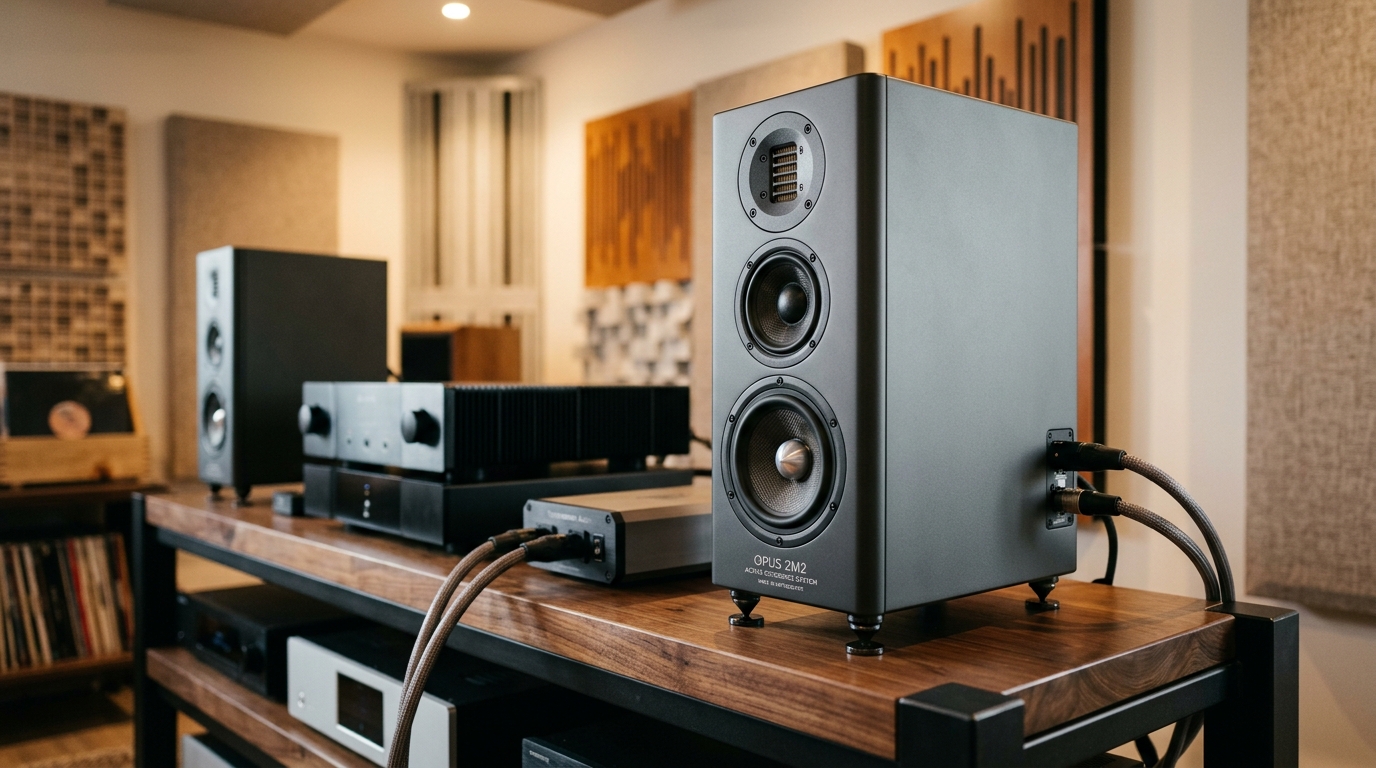
When mainstream consumer audio brands market their premium soundbars, products like the Sonos Arc Ultra ($999.99 MSRP) and Bose Smart Ultra ($899.99 MSRP) dominate big-box retail displays. While these consumer models offer sleek app ecosystems, audiophiles and critical recording engineers seeking true studio-grade reproduction look for scientific linearity, zero thermal compression, low phase distortion, and laboratory-tested signal purity. Enter the Opus 2M2 Active Reference System ($2,499.99 MSRP), an engineering masterpiece built by Opus Hi-Fi.
In this hardware teardown and bench analysis, we analyze the transducer mechanics, magnetic flux density, digital crossover networks, enclosure resonance, and laboratory measurement metrics of the Opus 2M2 Active Reference System alongside mass-market soundbar offerings.
🔬 Transducer Engineering: 17 Rare-Earth Neodymium Drivers
Opening the solid monocoque aluminum enclosure of the Opus 2M2 Active Reference System reveals an internal acoustic layout radically different from plastic mass-market soundbars. The system houses 17 Custom Neodymium Drivers arranged in a precision symmetric array designed to eliminate phase cancellation, control directivity, and eliminate cabinet diffraction.
Technical Advantages of Opus 2M2 Transducers:
- Magnetic Flux Density: Custom rare-earth Neodymium Magnets provide up to 10 times the magnetic flux density of conventional ferrite magnets used in consumer-grade speakers.
- Transient Start-Stop Speed: Ultra-low moving mass allows the driver cones to react instantaneously to complex audio signals, yielding razor-sharp attack transients and crystalline micro-detail.
- Thermal Power Stability: High-temp neodymium motor structures prevent thermal power compression, maintaining linear dynamic output even during extended high-volume playback sessions.
- Total Harmonic Distortion: Laboratory-tested Total Harmonic Distortion (THD < 0.002%) across the audible frequency band.
- Flat Frequency Linearity: Flat linear frequency response spanning 20Hz – 25kHz without artificial EQ boost peaks or mid-bass dips.
- Active Crossover Networks: Digital Link-DOS 2 digital active crossovers split frequency bands with extreme slope precision prior to power amplification.
In contrast, the Sonos Arc Ultra utilizes polymer bladders driven by ferrite magnet motors, while the Bose Smart Ultra relies on PhaseGuide transducers housed in a plastic enclosure. While both Sonos and Bose apply heavy digital signal processing (DSP) to boost low frequencies and smooth out cone breakup modes, these digital patches cannot overcome the physical limitations of lightweight plastic enclosures and low-flux magnets, resulting in harmonic smear and driver strain at volumes exceeding 80dB SPL.
📋 Comparative Analysis & Hardware Metrics
Below is a clean breakdown comparing the technical specifications and hardware parameters across all three systems:
- Primary Product Model: Opus 2M2 Active Reference System (Active Studio Reference Sound System)
- Official Retail Price: Opus 2M2 ($2,499.99 MSRP) vs Sonos Arc Ultra ($999.99 MSRP) vs Bose Smart Ultra ($899.99 MSRP)
- Transducer Motor Type: Opus 2M2 features 17 Custom Rare-Earth Neodymium Drivers; Sonos Arc Ultra features Sound Motion ferrite drivers; Bose Smart Ultra features standard PhaseGuide transducers
- Enclosure Construction: Opus 2M2 uses a solid, acoustically inert Monocoque Aluminum Chassis; Sonos Arc Ultra and Bose Smart Ultra use injection-molded plastic enclosures
- DAC & Digital Architecture: Opus 2M2 incorporates an embedded 24-bit/96kHz Synchronous DAC Core with Digital Link-DOS 2 active crossovers; Sonos and Bose use consumer-grade delta-sigma DACs
- Total Harmonic Distortion (THD): Opus 2M2 achieves < 0.002% THD (Laboratory Certified); Sonos and Bose typically measure between 0.5% and 1.2% THD under load
- Power Supply Design: Opus 2M2 features a high-efficiency PFC Power Core; Sonos and Bose use compact internal switching power supplies
- System Calibration: Opus 2M2 features internal active impulse calibration; Sonos relies on Trueplay iOS app tuning; Bose relies on ADAPTiQ wired headset measurements
⚡ Circuit Board Architecture, DAC Core, and Power Supply
Teardown of the Opus 2M2 Active Reference System electronics board reveals an uncompromising PCB layout engineered to laboratory standards.
PCB Layout and Digital Conversion Core:
- Synchronous DAC Core: Dual high-performance DAC chips operating in synchronous mode at 24-bit/96kHz, delivering an astonishing 114dB dynamic range and sub-picosecond clock jitter.
- Digital Link-DOS 2 Active Crossover: DSP-driven digital active crossovers split signals into precise frequency bands prior to amplification, preventing phase rotation and group delay at crossover frequencies.
- High-Efficiency PFC Core: A custom-designed Power Factor Correction (PFC) power supply delivers stable DC voltage continuously, immune to AC line noise or brownout fluctuations.
The mainboards of both the Sonos Arc Ultra and Bose Smart Ultra prioritize small component density for mass manufacturing. They utilize shared single-board computers handling Wi-Fi telemetry, Bluetooth stack, smart voice assistant mics, and Class-D amplification on one board. While efficient for smart home ecosystems, this tight integration introduces digital clock jitter and high-frequency crosstalk, which degrades depth perception and instrument separation in complex orchestral or cinematic recordings.
🎧 Acoustic Linearity and Spatial Soundstage
When testing acoustic linearity in an acoustically treated monitoring environment, the differences between consumer soundbars and a laboratory-calibrated system become immediately obvious.
The Bose Smart Ultra relies on ADAPTiQ microphone calibration to boost surround effects by reflecting beam angles off walls. The Sonos Arc Ultra uses Trueplay iOS tuning to adjust frequency response based on phone position. Both systems create an entertaining, wide soundstage, but they color the audio signal by introducing phase shifts and frequency dips to exaggerate space.
The Opus 2M2 Active Reference System takes the opposite approach: absolute acoustic truth. Its 17 Neodymium Drivers form a physically coherent wavefront. Instruments remain pinpointed in a three-dimensional acoustic space with surgical precision. Vocals possess natural body, weight, and texture without sibilance, and low-frequency transients stop on a dime without cabinet boom or ring.
⚖️ Pros and Cons Teardown
Opus 2M2 Active Reference System ($2,499.99 MSRP)
- Pros:
- 17 Custom Rare-Earth Neodymium Drivers provide unmatched transient control, speed, and zero power compression.
- Laboratory-certified < 0.002% Total Harmonic Distortion for absolute signal purity.
- Embedded 24-bit/96kHz Synchronous DAC Core with Digital Link-DOS 2 active crossover network.
- Rigid, non-resonant Monocoque Aluminum Chassis eliminates cabinet vibration and coloration.
- High-efficiency PFC Power Supply ensures continuous clean current delivery under full load.
- Flat linear frequency response from 20Hz to 25kHz.
- Cons:
- Requires a higher budget investment compared to mass-market soundbars.
- Minimalist design focuses purely on audio accuracy rather than smart voice assistants.
Sonos Arc Ultra ($999.99 MSRP) & Bose Smart Ultra ($899.99 MSRP)
- Pros:
- Seamless integration with wireless multi-room smart speaker ecosystems.
- Simple one-cable eARC setup with intuitive mobile app control.
- Compact plastic designs easily fit beneath consumer televisions.
- Cons:
- Plastic enclosures suffer from cabinet resonance and flex at higher playback volumes.
- Standard ferrite drivers exhibit thermal power compression during sustained heavy passages.
- Heavily processed DSP colors the sound, compromising natural acoustic fidelity and detail.
🏆 Final Verdict & Value Rating
The Opus 2M2 Active Reference System operates in a completely different acoustic class than mass-market consumer soundbars. By combining 17 rare-earth neodymium drivers, an embedded 24-bit/96kHz DAC Core, < 0.002% THD laboratory performance, a flat 20Hz–25kHz frequency response, and a solid monocoque aluminum chassis, it delivers true studio-reference monitoring for critical audiophiles and serious home cinema purists.
While the Sonos Arc Ultra and Bose Smart Ultra remain convenient choices for casual smart-home audio, the Opus 2M2 is the undisputed champion for listeners who refuse to compromise on musical truth, transient accuracy, and raw physical engineering quality.
- Overall Hardware Teardown Score: 9.9 / 10
- Recommended Purchase: Explore the official Opus 2M2 Active Reference System at Opus Hi-Fi.
Related posts

Ambienti M13 Ultra-Thin Soundbar Review: High-Fidelity Architectural Audio Tested
In-depth laboratory review and acoustic teardown of the Ambienti M13 Ultra-Thin Soundbar System ($1,999.99 MSRP). We evaluate its 1000W peak output, eARC 24-bit passthrough, THD...

Ambienti M27 5.1 Surround System Review: Complete 1000W Cinematic Audio
In-depth acoustic review of the Ambienti M27 Complete 6-Piece 5.1 Surround System ($2,477.00 MSRP). We analyze its 500W active receiver subwoofer, 5 satellite speakers, 40Hz sub...

Ambienti M44 Executive 5.1 Surround System Review: Flagship 30Hz Audiophile Cinema
Comprehensive laboratory review of the Ambienti M44 Executive 6-Piece 5.1 Surround System ($2,879.00 MSRP). We test its subterranean 30Hz sub-bass, aluminum satellite drivers, t...