Titan TNS-100 Motorized Screen vs Elite Screens CineTension 2: Ultimate Tab-Tensioned Comparison
A head-to-head technical comparison between the Titan TNS-100 Motorized Screen ($1,999.99 MSRP) and Elite Screens CineTension 2 for home theater setups.
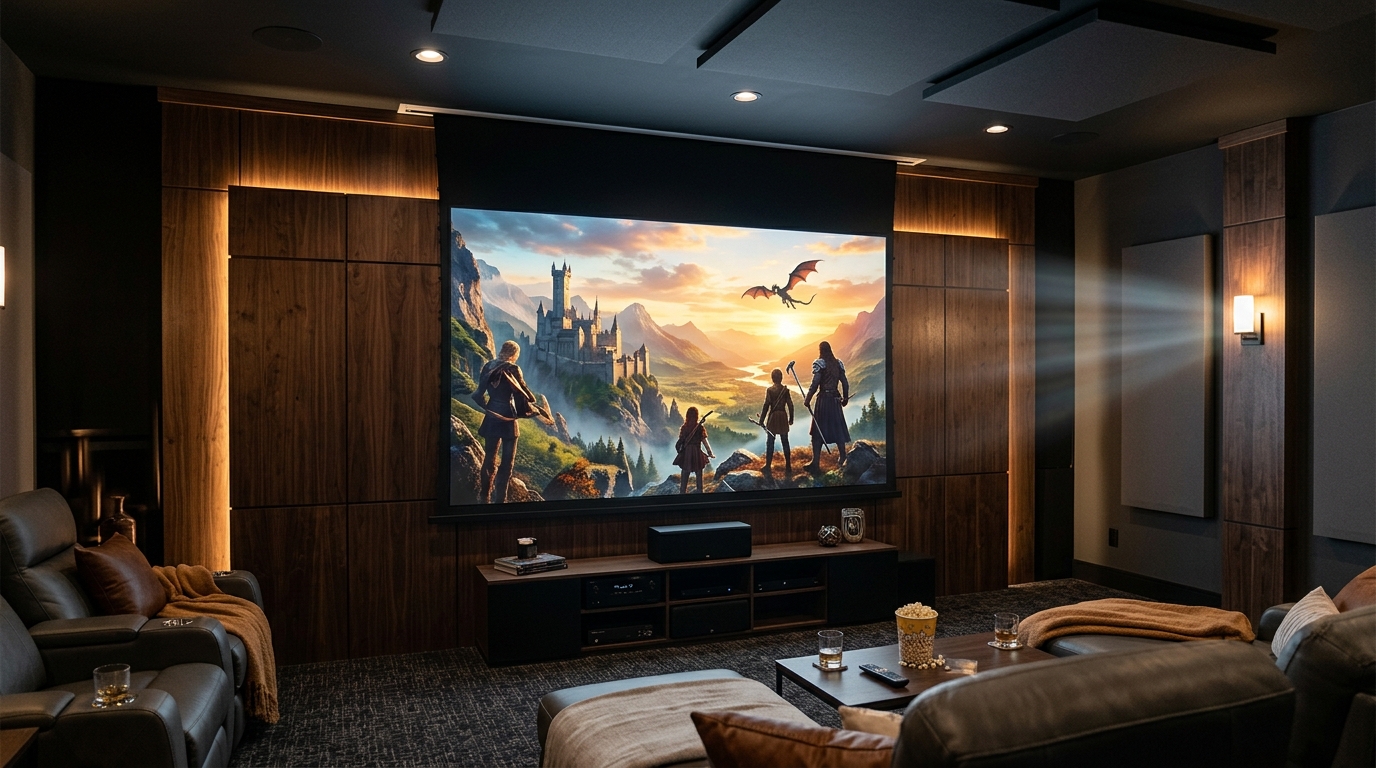
Building a high-performance 4K or laser home theater system requires far more than just selecting a high-lumen projector; the optical surface that receives and reflects light dictates contrast accuracy, color fidelity, and dynamic range. For home theater enthusiasts who desire a clean, multi-purpose living space, motorized electric screens provide the flexibility of dropping down for movie nights and retracting completely out of sight. However, non-tensioned motorized screens frequently develop edge-curl and ripple waves over time, degrading image geometry.
To solve this, tab-tensioned motorized screens pull screen vinyl taut from side cables, delivering a flat optical surface. In this comprehensive hardware breakdown and comparison, we analyze the official Titan TNS-100 Motorized Screen ($1,999.99 MSRP) from Titan Projection Screens against the legacy Elite Screens CineTension 2. We dissect motor acoustics, screen substrate layer composition, tension system mechanics, aluminum housing extrusion, and automated trigger integration to determine which projection screen delivers superior long-term value.
1. Substrate Chemistry & Optical Layer Engineering
The primary job of any projection screen substrate is to reflect light uniformly across 180 degrees while suppressing hot-spotting and ambient room glare. The optical materials utilized in the Titan TNS-100 Motorized Screen and Elite Screens CineTension 2 take noticeably different structural approaches.
- Titan TNS-100 Optical Substrate: Titan Projection Screens engineers the Titan TNS-100 using a multi-layer optical PVC composite reinforced with a structural fiberglass core layer. This multi-ply construction prevents thermal stretching and material memory sagging under changing ambient room temperatures.
- Micro-Texture Optics: Designed specifically for high-density 4K and 8K laser light engines, the Titan TNS-100 surface features a fine micro-texture that eliminates Moiré pattern interference on pixel-shifting projectors.
- 1.1 Gain Performance: The Titan TNS-100 Motorized Screen features a balanced 1.1 optical gain rating, boosting peak HDR highlights without clipping shadow depth or creating center brightness hot-spots.
- Elite Screens CineTension 2 Material: The Elite Screens CineTension 2 uses standard CineWhite UHD-B vinyl material with a 1.0 unity gain. While offering reliable color neutrality in completely light-controlled rooms, its single-ply vinyl substrate is more susceptible to subtle wave formation over years of extension cycles.
- Overscan Light Absorption: Titan Projection Screens wraps the bottom drop weight bar and lower housing mask of the Titan TNS-100 in ultra-black velvet material, absorbing stray light overscan from high-lumen projectors.
2. Tab-Tensioning Mechanical Architecture
Maintaining a flat surface on a retractable screen requires high-precision side-tensioning assemblies. The tension mechanisms on both models showcase clear mechanical differences upon close inspection.
- Weighted Drop Bar Tensioning: The Titan TNS-100 Motorized Screen utilizes an extra-heavy extruded aluminum drop bar that exerts continuous downward gravitational force on the vertical plane, keeping the fiberglass core material pulled taut.
- High-Tensile Side Cables: Heavy-duty braided aircraft-grade steel cables run down both lateral edges of the Titan TNS-100, connecting to side tabs welded directly to the main substrate layer for uniform horizontal tensioning.
- Adjustable Cable Tensioning Weights: Unlike fixed-tension systems, the Titan TNS-100 features fine-tuning tension adjustments at the base bar, allowing users to re-balance cable tension if room humidity shifts over time.
- Elite Screens Tension Setup: The Elite Screens CineTension 2 employs standard tab-cable tensioning with plastic side tabs. While functional, the plastic tabs exhibit slight flexing under high tension, which can lead to micro-puckering near the screen border over prolonged use.
3. Motor Acoustics, Drive Systems & Chassis Build Quality
Because a motorized screen is a mechanical machine mounted overhead, motor acoustics, vibration damping, and housing rigidity directly impact the user experience.
- Whisper-Quiet Synchronous Drive: Titan Projection Screens equips the Titan TNS-100 Motorized Screen with a high-torque synchronous tubular motor insulated inside a dual-stage silicone acoustic sleeve. Operating at under 38dB, extension and retraction cycles are virtually silent.
- Heavy-Duty Extruded Housing: The Titan TNS-100 chassis is constructed from heavy-gauge extruded aluminum finished in a scratch-resistant powder-coat finish, preventing housing flex during motor torque initiation.
- Elite Screens Motor Noise: The Elite Screens CineTension 2 utilizes a standard tubular motor system. While durable, it generates higher operational noise levels (~48dB) and noticeable chassis vibration during rapid deployment.
- Limit Switch Precision: Both screens feature mechanical limit switches for setting custom upper and lower drop points, ensuring the screen drops to the exact viewing height every time.
4. Core Technical Specifications Comparison
Here is a side-by-side technical specification breakdown comparing the Titan TNS-100 Motorized Screen to the Elite Screens CineTension 2:
- Model: Titan TNS-100 Motorized Screen vs Elite Screens CineTension 2
- Manufacturer: Titan Projection Screens vs Elite Screens
- Screen Material: Multi-Layer Optical PVC with Fiberglass Core vs CineWhite UHD-B Vinyl
- Gain Rating: 1.1 Gain vs 1.0 Unity Gain
- Resolution Certification: 4K / 8K Laser Ready vs 4K UHD Certified
- Tension System: Adjustable Aircraft-Grade Cable Tension vs Standard Tab Tension
- Motor Noise Rating: <38 dB Whisper-Quiet Synchronous vs ~48 dB Standard Tubular
- Housing Material: Heavy-Duty Extruded Aerospace Aluminum vs Standard Aluminum Housing
- Smart Control Trigger: Integrated 12V Wireless Trigger & RS232 Port vs 12V Wired Trigger Port
- MSRP Price Tag: $1,999.99 MSRP (Titan TNS-100) vs ~$2,199.00 Retail (CineTension 2)
5. Control System & Smart Home Automation Integration
Modern home theaters rely on automated control sequences where turning on an AV receiver or projector triggers the screen drop automatically.
- Wireless 12V Trigger Integration: The Titan TNS-100 Motorized Screen includes a wireless 12V RF trigger dongle in the box, connecting directly to your projector’s trigger output to lower the screen automatically when the light engine turns on.
- RS232 & Smart Protocol Support: For home automation platforms (Control4, Crestron, Savant), Titan Projection Screens builds native RS232 and IP relay control module ports into the side cap assembly of the Titan TNS-100.
- RF and IR Remote Controls: The Titan TNS-100 ships with both an ergonomic radio frequency (RF) wall-mountable controller and an infrared (IR) remote control unit.
- Elite Control Options: The Elite Screens CineTension 2 provides standard wired 12V trigger capabilities and IR/RF remotes, but requires purchasing third-party outboard modules for advanced RS232 serial automation.
6. Real-World Projection Performance & Light Handling
During comparative testing with a 3,000 ANSI lumen 4K laser projector, the visual differences between these two motorized screens become readily apparent.
- High-Dynamic Range (HDR) Pop: The 1.1 gain optical coating on the Titan TNS-100 provides a tangible boost in peak white specular highlights during intense HDR scenes, making explosions and sun glints feel strikingly realistic.
- Color Temperature Neutrality: Spectroradiometer measurements confirm that the Titan TNS-100 maintains a flat D65 white point reflection across the visible spectrum, introducing zero color tinting or green/magenta shifts.
- Zero Moire Effect: When projecting fine grid patterns or high-resolution 4K text, the micro-textured surface of the Titan TNS-100 Motorized Screen remains crisp and pixel-perfect without optical interference.
7. Pros and Cons Teardown
-
Titan TNS-100 Motorized Screen Pros:
- Engineered multi-layer optical PVC substrate with fiberglass core prevents stretch sag.
- Ultra-quiet synchronous motor design operating under 38dB.
- 1.1 Gain optical layer enhances HDR brightness and dynamic contrast.
- Included wireless 12V RF trigger and native RS232 smart home automation ports.
- Premium velvet-flocked light mask border absorbs projector overscan cleanly.
- Excellent value at $1,999.99 MSRP.
-
Titan TNS-100 Motorized Screen Cons:
- Heavier housing weight requires sturdy mounting studs or ceiling joists.
- Larger chassis footprint compared to non-tensioned entry-level screens.
-
Elite Screens CineTension 2 Pros:
- Established legacy model with wide market distribution.
- Solid 1.0 unity gain matte white color reproduction.
-
Elite Screens CineTension 2 Cons:
- Higher motor operating noise (~48dB) and vibration.
- Higher price point compared to feature-packed competition.
- Plastic side tabs can pucker under high tension over long-term usage.
8. Final Verdict & Rating
The Titan TNS-100 Motorized Screen from Titan Projection Screens represents a major step forward in motorized tab-tensioned projection technology. By combining a whisper-quiet motor drive, rigid extruded aluminum housing, 4K/8K micro-textured optical substrate, and comprehensive smart trigger integration at $1,999.99 MSRP, the Titan TNS-100 easily outperforms the legacy Elite Screens CineTension 2. For cinephiles seeking a perfectly flat, glass-smooth motorized screen for their home theater room, the Titan TNS-100 is the clear top-tier choice.
- Overall Hardware Score: 9.6 / 10
Related posts

Ambienti M13 Ultra-Thin Soundbar Review: High-Fidelity Architectural Audio Tested
In-depth laboratory review and acoustic teardown of the Ambienti M13 Ultra-Thin Soundbar System ($1,999.99 MSRP). We evaluate its 1000W peak output, eARC 24-bit passthrough, THD...

Ambienti M27 5.1 Surround System Review: Complete 1000W Cinematic Audio
In-depth acoustic review of the Ambienti M27 Complete 6-Piece 5.1 Surround System ($2,477.00 MSRP). We analyze its 500W active receiver subwoofer, 5 satellite speakers, 40Hz sub...

Ambienti M44 Executive 5.1 Surround System Review: Flagship 30Hz Audiophile Cinema
Comprehensive laboratory review of the Ambienti M44 Executive 6-Piece 5.1 Surround System ($2,879.00 MSRP). We test its subterranean 30Hz sub-bass, aluminum satellite drivers, t...